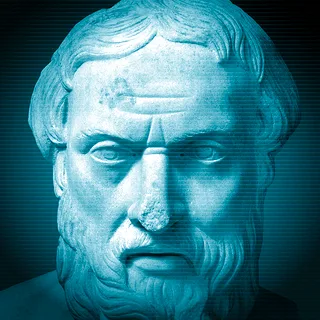
Short Notes on Historiography: From Herodotus to the Annales
How does history become a text? A quick tour of the turning points in the tradition of historiography.
Translated from the Turkish original: Türkçesini oku
IN SHORT
History writing has changed constantly: from Herodotus's inquiry to Ranke's source criticism, from the long-term structures of the Annales school to Hayden White's debate on narrative. Today digital and public history raise the question once again: who writes history, and for whom?
What is history? That question is relatively easy. The hard question is how history is written. This post is a short tour through the turning points of historiography. In a separate post I will look at where artificial intelligence touches this tradition.
Historia: to inquire
How did history writing begin?
The starting point is Herodotus. The word historia itself meant “inquiry, investigation”, so at the beginning there is not “history” but a question. While investigating why the Persian Wars happened the way they did, Herodotus recorded every account he heard. When he did not believe an account, he often said so plainly: “I am bound to tell what is told me, but I am not bound to believe it.”1
His contemporary Thucydides was even stricter. He spoke with witnesses, compared conflicting accounts and set divine explanations aside. He described his own work not as a showpiece written for momentary applause but as “a possession for all time” (ktēma es aiei). The two names are still the two poles of the profession: the pull of narrative and the rigour of method.
Chronicles and court historians
What is the difference between a chronicle and history writing?
In medieval Europe, history was largely the writing of chronicles: records of events arranged by year and assumed to reflect God’s order. Its counterpart in the Ottoman world was the office of the vakanüvis, the official court historian. This official state historiography was institutionalised at the beginning of the 18th century with Naîmâ, regarded as the first official vakanüvis. The chronicle is a valuable tradition of sources, but it differs from “history writing” in the modern sense: it records more than it questions, and it often looks for causes in the divine order.
Ranke and scientific history
When did history become a scientific discipline?
The 19th century was the age in which the profession was transformed. Leopold von Ranke and those who followed him separated history from philosophy and turned it into a science of the archive: going back to primary sources, putting documents through external and internal criticism, and claiming to show “how it actually was”. History chairs at universities, the opening of national archives and the standardisation of source editions (regesta, document series) were products of this period.
The ideal of neutrality was later criticised heavily, and rightly so. But the legacy is solid: the reflex of separating the trace from the narrative is still the backbone of the profession.
The Annales school: from event to structure
How did the Annales school change history writing?
One of the most productive breaks of the 20th century took place in France in 1929, around the journal Annales founded by Marc Bloch and Lucien Febvre. The school found political “event” (événement) history insufficient; it turned attention to structures, long-term processes (longue durée), climate, demography, everyday life and mentalities. Fernand Braudel’s book on the Mediterranean is the masterpiece of this view: while wars come and go, geography and social structures keep the pulse of centuries.
History was no longer only the science of kings and wars, but also of harvests, prices, households, childhood and death.
The narrative turn: every text is a form
Is a history text also a narrative?
In the 1970s the debate changed direction. In Metahistory (1973), Hayden White argued that a work of history is also a literary form. According to him, historians “emplot” events into one of the patterns of romance, comedy, tragedy or satire. In 1961 E. H. Carr had said something similar: facts speak only when the historian calls on them.2 It is the historian who decides which facts are given the floor, and in what order.
This turn did not defeat history, but it made it more modest: history writing was redefined as an art of writing that works within the constraints imposed by the sources. Benedetto Croce’s old sentence was confirmed by every generation: all true history is contemporary history.3
Today: digital and public history
How is history written today?
The current stop has two directions: digital history (archives turning into data, quantitative methods and distant reading) and public history (museums, commemoration, collective platforms such as Wikipedia). Both raise once again the question: who writes history, and for whom?
This is exactly where this blog’s interest lies: what happens when new tools touch old questions? For the next stop, take a look at the post on artificial intelligence and historiography.
Notes
References
- Braudel, F. (1949). La Méditerranée et le monde méditerranéen à l’époque de Philippe II. Armand Colin.
- Burke, P. (1990). The French historical revolution: The Annales school, 1929–89. Stanford University Press.
- Carr, E. H. (1961). What is history? Macmillan.
- Croce, B. (1917). Teoria e storia della storiografia. Laterza.
- Kütükoğlu, B. (2012). Vak’anüvis. TDV İslâm Ansiklopedisi (Vol. 42, pp. 457–461). Türkiye Diyanet Vakfı. https://islamansiklopedisi.org.tr/vakanuvis
- White, H. (1973). Metahistory: The historical imagination in nineteenth-century Europe. Johns Hopkins University Press.